
Langue : English

Publié 2024 par Doherty Associates, LLC, Tom.

ISBN :
978-1-250-29028-1
ISBN copié !

Voir sur OpenLibrary

o fix the world they first must break it further.

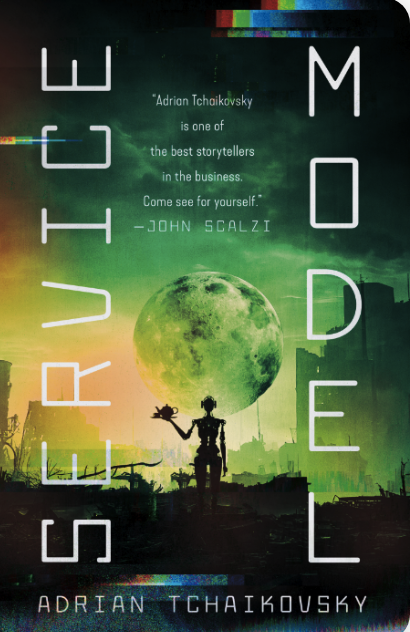
Humanity is a dying breed, utterly reliant on artificial labor and service. When a domesticated robot gets a nasty little idea downloaded into their core programming, they murder their owner. The robot then discovers they can also do something else they never did before: run away. After fleeing the household, they enter a wider world they never knew existed, where the age-old hierarchy of humans at the top is disintegrating, and a robot ecosystem devoted to human wellbeing is finding a new purpose.

6 éditions

The Robot Apocalypse from the perspective of Charles a robot valet

Charles, a robot valet, unexpectedly murders his employer. He then sets out on a journey to Diagnostics to find out why he did it, and starts a heroes journey of sorts. Through seven episodes, mostly accompanied by the Wonk, who he meets at Diagnostics, he journeys through a societal landscape where humans are mostly dead or scrabbling to survive.

So what happened? The Wonk wants it to be that robots have obtained self-awareness. Charles just wants to be a valet for a human, but is complex enough to act unhappily at some of his opportunities. Even though he claims to be incapable of unhappiness.

I found myself really liking Charles, but that may be my internal tendency toward the satisfaction of ticking off tasks on a task list, which is what a lot of Charles' internal monologue is about. The overall story is good, but it is overly …

Road trip mashup with social commentary

Aucune note

I haven’t previously read anything by this author. I gather Service Model isn’t his usual style. From the blurb, it looked to be an intriguing combination of dystopian adventure and comedy of manners.

I think my first impression was fairly accurate. We have UnCharles as the sole viewpoint character trying to understand and interact with the world within the (sort of) constraints of his programming, instead of limited by social conventions. We follow him and The Wonk on a journey that satirises several well known literary works. (Or maybe parodies? I never remember what the terms mean...) I’m only passingly familiar with those, so I may not have appreciated all the references.

In terms of plot, the structure wasn’t your standard sci-fi adventure. I’d say UnCharles was a traveller experiencing different showcased environments in a scripted way, rather than a robot on a mission, even if that’s what …

Light satirical tale of a robot valet after the apocalypse.

The somewhat satirical tale of Uncharles, a robot programmed as valet traveling across a collapsing, nearly post-human society, after the death of its master.

Very reminiscent of a lot of 50s and early 60s sci-fi, in that it uses bits of the apocalypse setting to satirize modern scoeity. It's pleasant, but somewhat unchallenging. Good as a lighter read.

a publié une critique de Service Model par Adrian Tchaikovsky (duplicate)

dystopian robot future with an underlying warmth

Reminiscent of Monk and Robot though broader and darker, we're along for a calm inquisitive road novel with an earnest robot butler some moment after the world as they and we know it ended. Satirically enjoys itself in upending formulaic scenes and takes us to some imaginative places, surprisingly light fun.

Meets optimal performance targets

This book starts with a bunch of absurd humor, and as the story goes on, that humor gets mixed in with the darkness of the dystopian setting and overall plot. It kind of resembles Tchaikovsky's Cage of Souls, but whereas that book was more adventure, this one is more dark comedy.

Tchaikovsky does manage to pull off the combination well. The main character, being a robot, brings a bunch of robotic aloofness to the narration, which actually works pretty well with the overall mixture of simultaneously aloof and dark tone of the book. While the main character keeps encountering perhaps too-poignant and neatly tied up episodes of his adventure, like the hero in some sort of a fable (which is where the comparison to Cage of Souls comes to mind), the character is sufficiently compelling to carry the book forward.

The conclusion to the overall plot could perhaps …